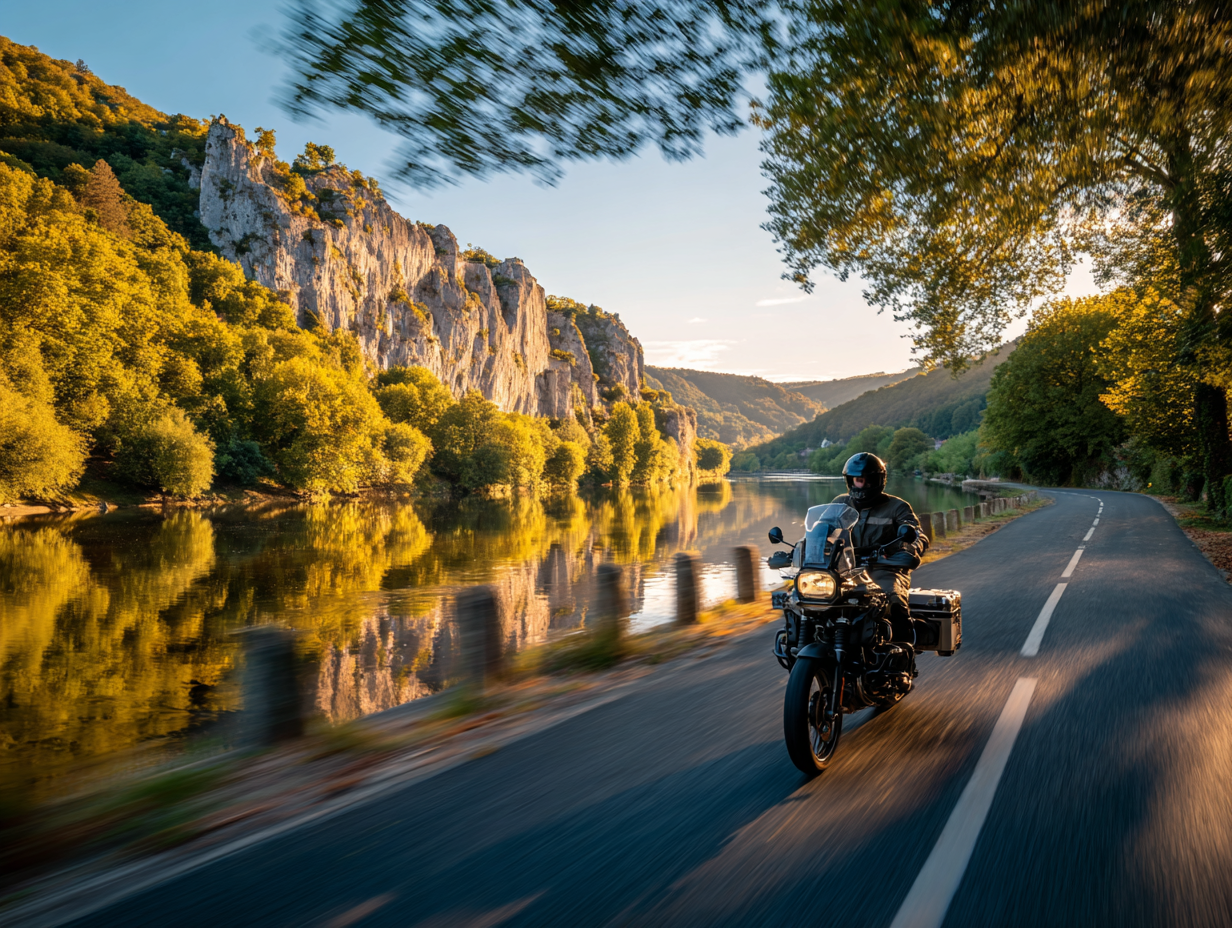
The Pyrenees are one of Europe's greatest motorcycle destinations — and still less crowded than the Alps. Stretching between France and Spain, this mountain range offers everything riders dream of: smooth tarmac, endless curves, high-altitude passes, and scenery that changes register every 20 kilometres. This guide covers the 10 most spectacular roads you should not miss — whether you are planning a full tour or choosing individual days.
Col du Tourmalet — The Most Famous Road in the Pyrenees
The Col du Tourmalet is the highest paved mountain pass in the French Pyrenees and the one against which all others are measured. It has appeared in the Tour de France more times than any other col — 87 at the last count — and the approach from Sainte-Marie-de-Campan is a masterclass in progressive drama: forested valley, tightening hairpins, a sudden opening into alpine terrain above La Mongie, and a final 4-kilometre stretch at 2,115m with views in every direction.
The road surface is excellent and well-maintained. The curves are wide and satisfying without being lazy. The only variable is traffic on summer weekends — ride early, before 9am, and you will have one of the great mountain roads largely to yourself.
- Wide sweeping curves above La Mongie
- 360° panorama at 2,115m
- Excellent road surface throughout
- Café and facilities at the summit
Col d'Aubisque — Balcony Roads and Cliff-Edge Drama
The Aubisque is the Tourmalet's dramatic counterpart — lower in altitude but arguably more theatrical in character. The road between the Aubisque and the neighbouring Col du Soulor runs along a cliff face with sheer drops on one side and no barriers — the Cirque du Litor traverse, one of the most extraordinary kilometres of tarmac in Europe. The rhythm of the approach from Laruns through Eaux-Bonnes is superb: long, flowing curves through beech forest before the road breaks into open moorland and the exposure begins.
- Cirque du Litor cliff-edge traverse
- Exceptional photo opportunities
- Smooth, flowing riding rhythm
- Best combined with Col du Soulor
Col de Peyresourde — The Smoothest Ride in the Range
The Col de Peyresourde at 1,569 metres is consistently underrated — perhaps because it sits between the more celebrated Tourmalet and Aspin on the classic Tour de France stage, and ends up as the opening act rather than the main event. That, for the motorcyclist, is exactly the reason to seek it out. The road from Bagnères-de-Luchon is wide, well-surfaced, and follows a rhythm of medium-radius curves through open mountain pasture that allows you to settle into a flow that is genuinely satisfying to sustain. Intermediate riders will find it the most purely enjoyable climb in the central Pyrenees.
- Smooth, technical medium-radius curves
- Ideal for intermediate riders
- Connects naturally to Col d'Aspin and Tourmalet
- Light traffic even in high summer
Col d'Aspin — Open Landscapes and the Perfect Warm-Up
The Col d'Aspin at 1,490 metres is the classic warm-up for the Tourmalet — a forested climb from Sainte-Marie-de-Campan with a gradient that builds gradually and summit views across open pasture toward the Néouvielle massif. The curves are gentler than the Tourmalet, the gradient more forgiving, and the summit plateau wide and unhurried. What makes it excellent riding is precisely the rhythm it establishes: by the time you reach the valley floor on the descent toward Arreau, you are calibrated for what the Tourmalet will demand.
- Open, spacious summit plateau
- Forested lower slopes, panoramic upper section
- Excellent natural pairing with the Tourmalet
- Pyrenean horses often graze near the summit
"These ten roads share one quality: they give back precisely as much as you put in. The Pyrenees do not do passive riding."
Col de la Bonette — The Highest Paved Road in Europe
The Col de la Bonette is technically in the Alps — the Alpes-Maritimes, at the eastern extremity of the mountain arc — but it appears regularly on extended Pyrenees tours, particularly those riding the full Atlantic-Mediterranean crossing. At 2,802 metres via the summit loop road, it is the highest paved road in Europe. The switchbacks above the treeline are tight and relentless, the air noticeably thinner, and the views across the Mercantour National Park to the south are extraordinary. If you are riding east from the Pyrenees toward the Mediterranean, the Bonette is the defining high point of the journey in every sense.
- Highest paved road in Europe at 2,802m
- Tight switchbacks above 2,500m
- Mercantour National Park panorama
- Natural finale for a full Atlantic–Mediterranean crossing
Col du Portet d'Aspet — Narrow, Technical, Authentic
The Col du Portet d'Aspet at 1,069 metres sits in the quieter, less-touristed Haute-Garonne department to the east of the main central Pyrenees cluster — and that relative obscurity is precisely its character. The road is narrow, the sections through forest genuinely technical, and the traffic minimal even in high summer. It demands attention in a way the wider, better-known passes do not, and rewards it with an authenticity that the showcase cols cannot quite match. Regular Tour de France fixture since the 1950s. The descent toward Saint-Gaudens on the northern side is one of the best fast descents in the range.
- Narrow, technical sections through dense forest
- Minimal traffic year-round
- Authentic, non-tourist atmosphere
- Fast, rewarding northern descent
N-260 — The Best Motorcycle Road in Spain
The N-260 runs east-west along the southern side of the Pyrenees from Jaca to the Mediterranean coast near Figueres — roughly 500 kilometres of continuous mountain road through the Spanish Pyrenees, the Aragonese pre-Pyrenees, and the Catalan foothills. It is frequently cited as one of the best motorcycle roads in Europe, and the citation is deserved. The asphalt quality is consistently excellent. The curves are varied and engaging — tight switchbacks in the high sections, flowing medium-radius bends in the valleys. Traffic is a fraction of what the French side carries. The views south into the Ebro plain and north toward the main ridge alternate in a way that keeps the riding visually rewarding throughout.
- ~500km of continuous mountain road
- Best asphalt quality in the Pyrenees region
- Low traffic throughout
- Passes through Ordesa National Park corridor
Col de Pailhères — The Ariège's Untamed Giant
The Col de Pailhères at 2,001 metres sits in the Ariège department — the eastern Pyrenees, less visited than the Hautes-Pyrenees and considerably wilder in character. The road from Ax-les-Thermes climbs through successive altitude bands: beech forest, then open moorland, then the exposed rocky terrain above 1,800m where the landscape becomes genuinely austere. The elevation changes are sharp, the corners less groomed than the showcase passes, and the summit — when it comes — feels like something earned rather than delivered. A particular favourite of riders who have already done the central cols and are looking for something less curated.
- Rugged, dramatic upper section above 1,800m
- Sharp elevation changes on both sides
- Significantly less traffic than central cols
- Natural extension of an Ax-les-Thermes base
Cirque de Gavarnie Route — Riding into a Natural Cathedral
The road from Luz-Saint-Sauveur to the village of Gavarnie leads into one of the most spectacular natural amphitheatres in Europe — the Cirque de Gavarnie, a UNESCO World Heritage Site and a glacially carved horseshoe of cliff 1,400 metres high with the Grande Cascade waterfall dropping 422 metres from the snowfield above. The road itself is relatively straightforward — good surface, moderate gradient, manageable traffic — but the destination justifies the ride entirely. The approach through the increasingly vertical landscape of the Gave de Pau gorge is itself remarkable, with the walls closing in progressively as you ascend. Stop in the village and walk to the cirque: the scale of what surrounds you is only apparent on foot.
- UNESCO World Heritage destination
- 422-metre waterfall at road's end
- Progressive gorge scenery on approach
- Suitable for all riding levels
Col de Menté — A Technical Rider's Dream
The Col de Menté at 1,349 metres is compact, technical, and thoroughly enjoyable — a pass that rewards precision over speed and delivers a kind of focused satisfaction that the longer, more celebrated roads do not quite match. The tight switchbacks on the southern ascent from Saint-Beat demand consistent line discipline and give the corners a quality that keeps you thinking for the entire climb. Traffic is minimal. The forest scenery is dense and atmospheric. The descent toward Saint-Gaudens on the northern side opens into faster curves before the valley floor. A perfect afternoon road, and an excellent warm-down from the more demanding cols to the west.
- Tight, technically demanding switchbacks
- Minimal traffic — rarely congested
- Dense forest atmosphere throughout
- Fast, flowing northern descent
Suggested 5–7 Day Pyrenees Itinerary
To ride all ten roads without rushing, allow at least five days — seven is better. The structure below covers the French and Spanish sides in a logical east-meets-west sequence, with the central cols clustered on days three and four for maximum impact.
| Day | Zone | Roads | Distance |
|---|---|---|---|
| Day 1–2 | Western Pyrenees | Col d'Aubisque, Col du Soulor, Col du Portet d'Aspet | ~180 km/day |
| Day 3–4 | Central cols | Col d'Aspin, Col de Peyresourde, Col du Tourmalet, Col de Menté | ~160 km/day |
| Day 5 | Spanish side | N-260 west–east traverse, Cirque de Gavarnie detour | ~220 km |
| Day 6 | Eastern Pyrenees | Col de Pailhères, Ax-les-Thermes area | ~140 km |
| Day 7 | Return | Scenic valley roads — Ariège, Garonne, Gers | ~200 km |
Essential Tips for Riding in the Pyrenees
Best Time to Ride
- Season: May to October
- June: empty roads, vivid green
- July–August: best weather, more traffic
- September: golden light, empty roads
- Avoid high passes before late May
Fuel & Planning
- Fill up before every col approach
- Luz-Saint-Sauveur before Tourmalet
- Laruns before Aubisque
- Saint-Lary before Portet
- Summit cafés rarely sell fuel
Road Conditions
- Watch for gravel after rainfall
- Livestock on high-altitude roads
- Afternoon cloud can close passes quickly
- Download offline GPS maps
- Pack waterproofs regardless of forecast
Want to ride these roads without the planning?
Our guided tours cover the best of these ten roads in a carefully sequenced itinerary — hotels pre-booked, routes GPS-loaded, support vehicle on call. You just ride.
Final Thoughts
The Pyrenees offer something rare in Europe: world-class motorcycle roads without the crowds. From the legendary Col du Tourmalet to the technical Col de Menté, from Spain's open N-260 to the wild Col de Pailhères in the Ariège, this range delivers a variety and quality of riding that justifies the journey from anywhere on the continent. Plan carefully, start early, and leave room for the roads you didn't plan to stop on.